
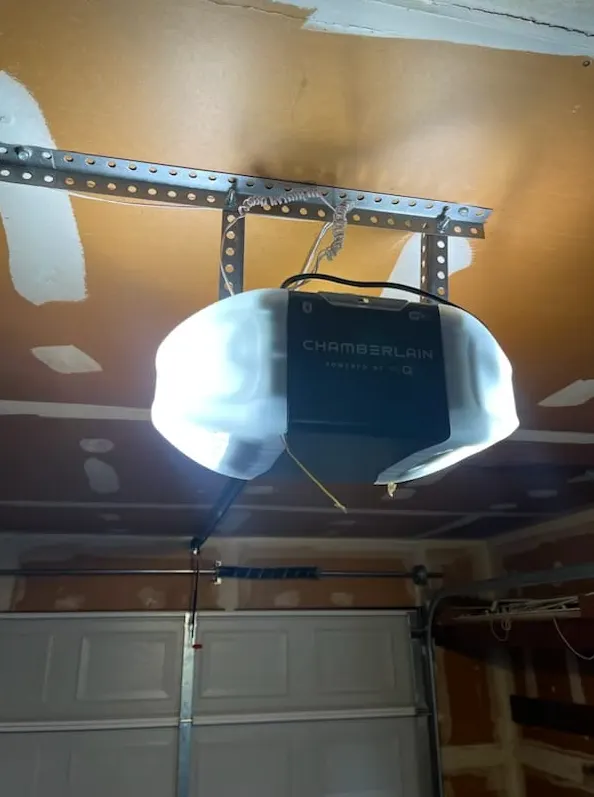
You're sitting in the driveway, thumb mashing the remote, and the opener motor doesn't even hum. Or you walk into the garage, hit the wall button on your way to grab something from the freezer, and nothing happens at all — no click, no light, no movement. Either way, the first instinct is to assume the whole unit is dead. Most of the time it isn't. An opener that ignores both the remote and the wall button usually has one failure point feeding both symptoms, and it's almost always something a tech checks in the same order every time.
What You'll Notice Before You Call Anyone
The pattern matters. Does the opener's light come on but the motor stays silent? Does pressing the wall button do nothing, but you can still hear a faint click from inside the unit? Is the remote dead from across the garage but works if you stand directly under it? Each of these points somewhere different, so before any troubleshooting starts, it helps to note exactly what does and doesn't happen.
Step One: Power to the Unit
This sounds obvious, but it's the first thing checked because it's the most common culprit. Garage openers run off a dedicated outlet, often on a GFCI circuit, and those outlets trip more often than people expect — especially after the kind of humidity swings that come with Central Valley winter rain moving in after a dry summer. Check the outlet with another device, check the breaker panel, and check for a tripped GFCI reset button on the outlet itself or a nearby one. If the opener's light isn't on at all, this is where to start, not the remote.
Step Two: The Remote and Wall Button Themselves
If power is confirmed, the next check is the simplest part of the system. Remote batteries die quietly; there's no warning light. Swap them before assuming anything electronic has failed. For the wall button, the wiring is thin, low-voltage cable that's easy to nick with a shelf bracket or chewed by rodents looking for shelter from summer heat. A loose or corroded connection at the button or at the motor unit terminal block can make the button feel completely dead. Pulling the button off the wall and checking the wire nuts or screw terminals behind it is a five-minute job that solves this more often than people expect.
Step Three: Signal and Programming
If the wall button works but the remote doesn't, the issue usually lives between the remote and the opener's receiver, not inside the motor. Rolling-code systems can lose sync if the remote's battery was pulled and reinserted, or after a power outage. Reprogramming the remote following the manufacturer's reset sequence (usually a button on the motor unit held for several seconds) resolves this in most cases. If that doesn't work, interference is worth ruling out — newer LED garage bulbs, nearby Wi-Fi extenders, and even some vehicle keyless entry systems can crowd the same frequency band and garble the signal.
Step Four: The Safety Sensors
Here's the one that trips up a lot of homeowners, because it affects the wall button too, not just the remote. If the photo-eye sensors near the bottom of the tracks are misaligned, dirty, or blocked, many openers refuse to respond to any command, remote or button, as a safety lockout. Dust kicked up during dry months, or a spiderweb across the lens, is enough to trigger this. Look for a steady light on both sensor units; a blinking light usually means misalignment or an obstruction. Wiping the lenses and nudging the sensor until both lights go solid fixes this more often than any other step on this list.
Step Five: Limit Switches and Logic Board
If everything above checks out and the opener still won't respond, the problem is likely internal — either the limit switches that tell the motor where the door should stop, or the logic board itself. Logic boards can fail from age, from power surges during storm season, or simply from years of heat cycling in an uninsulated garage. This isn't a DIY repair; it usually means replacing the circuit board or, if the unit is old enough, replacing the opener outright.
Step Six: The Motor and Capacitor
Last on the list because it's the least common cause of total unresponsiveness. A failing capacitor or burned-out motor winding can prevent the unit from engaging at all, even though power, remote, and sensors are all fine. This usually shows up alongside other symptoms — a faint hum, a burning smell, or a door that moves a few inches and stops.
When to Call Tracy Garage Door Co
If you've checked power, batteries, and sensor alignment and the opener still ignores every command, it's time for a technician rather than more guesswork. Tracy Garage Door Co handles both Garage Door Opener Repair & Installation and full Emergency Garage Door Service for homes across Tracy, Manteca, Lathrop, and the surrounding area, and we carry the diagnostic tools to test the logic board and limit switches on site rather than replacing parts by guesswork.
If your garage door in Tracy, CA isn't answering the remote or the wall button, give us a call and we'll get it moving again.